James A. Rhodes, Ohio Colossus by Tom Diemer & Lee Leonard & Richard G. Zimmerman
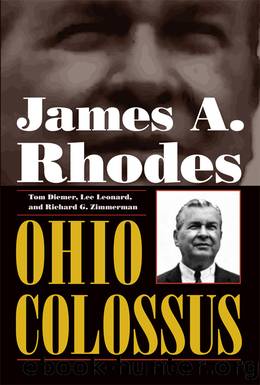
Author:Tom Diemer & Lee Leonard & Richard G. Zimmerman [Diemer, Tom & Leonard, Lee & Zimmerman, Richard G.]
Language: eng
Format: epub
Tags: Korean War, Military, Biography & Autobiography, History, Political
ISBN: 9781606352151
Google: uZWvngEACAAJ
Goodreads: 20673872
Publisher: Kent State University Press
Published: 2014-01-15T10:25:13+00:00
CHAPTER 11
Recession!
HELEN RHODES HAD NO DOUBTS about her hyperactive husbandâs energy level or his resolve. In an impromptu exchange with reporters after Rhodes returned from China, she said he âcanât sit still.â He wonât retire after his term as governor ends in 1982, she said. âHe has his fingers in several things.â1
Rhodes, in fact, did not stand by and wait for a free-market miracle as the economy worsened; he was engaged. But what he didnât have his fingers in was the debate over the ânew economy,â fundamental shifts in the job market that would take hold in the last two decades of the twentieth century. At universities and think tanks, economists were talking about structural changes they believed would alter Ohioâs industrial base and point toward the emerging communications, service and health care sectors, alternative energy, and smaller, specialized manufacturing plants.
âThat lexicon was foreign to his experience,â said Bill Wilkins, who by 1980 was heading the Department of Administrative Services for Rhodes.2 Manufacturing jobs peaked nationally at 19.6 million in 1979, but heavily unionized states like Ohio, Michigan, and Illinois were already being written off as the Rust Belt.3 Employers looked to cheaper labor and warmer climes in Georgia, South Carolina, and Texasâthe Sunbelt. With its northern cities shrinking, Ohio was losing population, jobs, and also clout on Capitol Hill. Its congressional delegation slipped from twenty-one to nineteen after the 1980 census showed only modest growth in the state.4
âAfter the Carter economy and when things got better for Ohio economically, I donât think the governor appreciated that there was an evolution from smokestacks to high techâand I donât think many people did,â said Rhodesâs executive assistant Robert Howarth. âI donât think we were talking about high tech. However, he did know that the key to Ohioâs economic future and success was the work force and the young people being trained.â5 Howarthâs predecessor, Tom Moyer, had a similar take. âHe certainly was not a Third Frontier person in the last term. For him, big manufacturing, that is where his heart was. He understood it. He thought, too, it created so many jobs.â6
Nor was Rhodes a booster of a service economy. âWe canât all sit around and cut each otherâs hair,â he was fond of saying when the topic came up. Rhodesâs critics believed his best years were behind him âIn his last two terms, his administration didnât have a handle on what was going on,â said State Representative Robert Netzley, a western Ohio Republican to the political right of Rhodes. âThings just seemed to run out of control.â7 Senate Leader Ocasek said Rhodes clung to a philosophy, which I have been slower to adopt: âwhatâs good for industry is good for Ohio.â8
Inflation roared across the country in February 1980 at an 18.2 percent compounded annual rate.9 In April, the United Statesâ industrial production dropped by nearly 2 percentâthe steepest slide since early 1975. General Motors reacted to slumping sales by furloughing more than four hundred at Cleveland area factories; Ford Motor
Download
This site does not store any files on its server. We only index and link to content provided by other sites. Please contact the content providers to delete copyright contents if any and email us, we'll remove relevant links or contents immediately.
The Vikings: Conquering England, France, and Ireland by Wernick Robert(84419)
Ali Pasha, Lion of Ioannina by Eugenia Russell & Eugenia Russell(40334)
The Conquerors (The Winning of America Series Book 3) by Eckert Allan W(38067)
The Vikings: Discoverers of a New World by Wernick Robert(37024)
Cecilia; Or, Memoirs of an Heiress — Volume 1 by Fanny Burney(32654)
Cecilia; Or, Memoirs of an Heiress — Volume 2 by Fanny Burney(32023)
Cecilia; Or, Memoirs of an Heiress — Volume 3 by Fanny Burney(32005)
Empire of the Sikhs by Patwant Singh(23150)
The Secret History by Donna Tartt(19352)
Hans Sturm: A Soldier's Odyssey on the Eastern Front by Gordon Williamson(18664)
Cat's cradle by Kurt Vonnegut(15466)
Pimp by Iceberg Slim(14710)
Sapiens: A Brief History of Humankind by Yuval Noah Harari(14480)
Norse Mythology by Gaiman Neil(13472)
Talking to Strangers by Malcolm Gladwell(13471)
Leonardo da Vinci by Walter Isaacson(13427)
4 3 2 1: A Novel by Paul Auster(12541)
Underground: A Human History of the Worlds Beneath Our Feet by Will Hunt(12172)
The Radium Girls by Kate Moore(12112)
